中文 |


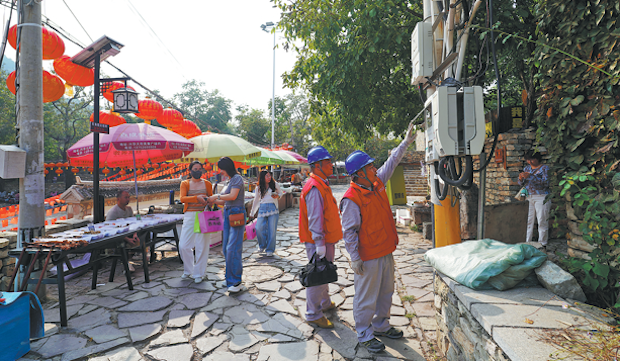
Engineers inspect electricity facilities at a commercial street in the village. ZHENG LANXIN/FOR CHINA DAILY
Between 2017 and 2018, local authorities and utility planners initiated a total overhaul of the village's utility footprint. To avoid cluttering the skyline with utility poles and dangling cables, engineers buried supply lines directly beneath the historical flagstone lanes and placed distribution transformers discreetly outside the primary scenic zones.
Engineers replaced the two overloaded transformers with 13 distribution units, boosting total power capacity nearly 100-fold.
By 2022, the village's annual electricity demand reached 3.32 million kilowatt-hours.
"You can't see a single wire along the lanes now," said Zhou Jian, a village official. "That was non-negotiable for us. The stone scenery is why people come here. Exposed poles and wires would have ruined the whole aesthetic."
Wu Xiangyi, director of the urban power supply service center at State Grid Tianjin Jizhou Power Supply Co, said the biggest challenge of the upgrade was making it invisible. "Over two-thirds of the village's buildings are stone-built, with narrow lanes and strict aesthetic requirements," Wu said. "We adopted a scheme of buried cables along flagstone lanes and transformers placed discreetly outside core scenic areas. Preserving the village's stone character was always our top priority."
Seventy-three guesthouses have now fully converted from coal and gas to electric power, covering heating, cooling, hot-spring water heating, cooking and lighting.
Even the traditional brick kang beds have been preserved in form but upgraded to electric heating. They retain their rustic look and cozy feel, but operate cleanly with precise temperature control, extending the village's tourist season by three months into winter.
"Our guests love the traditional kang bed experience, but they don't want the coal dust," said Shi Chao, manager of Tianjin Jizhou Yuyang Tourism Development Co. "Now we have the best of both worlds — the nostalgia of an old stone village, with all the comfort of modern electricity. Green power plays a vital role here."
Chen Xu, deputy head of the market management and industry development division at the Jizhou district culture and tourism bureau, said Xijingyu is a textbook example of how greener energy supply can resolve the long-standing tension between heritage protection and tourism development in ancient villages.
"Jizhou is home to more than 500 registered homestays across many historical villages. What worked here can be replicated elsewhere, proving that preservation and prosperity don't have to be trade-offs," Chen said.
For visitors arriving in new energy vehicles, 29 public charging points have been installed across Xijingyu, backed by a dedicated 630 kVA charging transformer, eliminating range anxiety for self-drive tourists from nearby cities.
"We planned our trip specifically because we knew there were chargers here," said Sun Weitao and his wife, a young couple from Tangshan, Hebei province, topping up their car before hiking nearby Fujun Mountain. "It makes a weekend trip to a mountain village completely stress-free."

Copyright © Tianjin Municipal People's Government. All rights reserved.

Copyright © Tianjin Municipal People's Government. All rights reserved.