中文 |


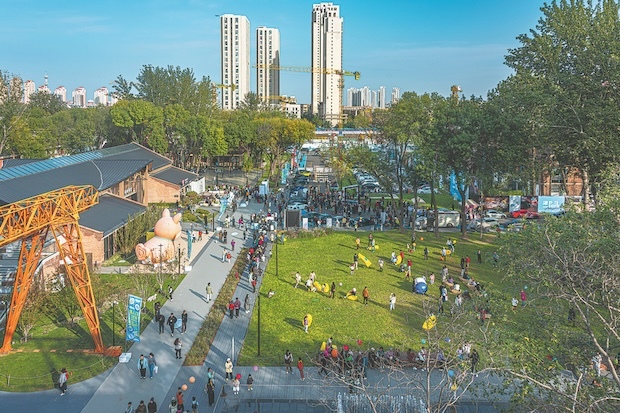
Visitors relax on the lawns of Jinyi Park with friends and pets. The renovated park is home to multiple new businesses including cafes, restaurants and bookstores.[Photo/China Daily]
Elevated experience
Before Lyu Chenghua became involved in the redevelopment of a disused textile factory in Xiqing district, weeds choked its grounds. Redbrick workshops that had stood idle for years, offered little indication of the restaurants, cafes and bars that would eventually fill the compound.
Lyu, an investor in the redevelopment, had considered 13 sites for an industrial-themed project before settling on the former textile factory. He wanted something different from a conventional commercial complex.
"When you develop a site in an old factory, people are drawn to the city's memories, its industrial character and the stories behind it," he said.
His concept has materialized via an elevated walkway known as the Years Corridor that spans more than 200 meters, connecting 35 buildings.
Visitors climb a retro-style staircase to look across a patchwork of redbrick roofs and old trees growing between buildings with the city's modern skyline in the background.
The elevated route is among the site's most recognizable attractions, with designated spots for photographs and nearly 30 other interactive features aimed at younger visitors. On the restored roof of an old workshop, visitors can walk across weathered tiles.
The former factory has become a place to eat, drink, shop and spend an evening out.
The Tianjin Sezhi Factory tourism and leisure block opened to the public in May 2026. In its first three months of trial operation, it received about 2 million visits, according to local media reports. Average daily foot traffic exceeded 20,000 on weekdays and 30,000 on weekends and holidays, the reports said.
Around 100 businesses occupy about 15,000 sq m of renovated space. They include restaurants, specialty coffee and tea shops, children's activities centers, creative retail outlets and intangible cultural heritage workshops.
For Lyu's team, the challenge was to make these businesses functional without erasing the history of the original buildings.
Tenants have retained original workshop layouts and industrial features in their designs. Some coffee shops have built counters over abandoned textile-machine stations, while restaurants leave steel beams and concrete walls exposed. Creative shops use old yarn spindles and weaving shuttles as display pieces.
The restoration itself required considerable work. Some walls had collapsed and had to be rebuilt on their original sites, while roofs needed repair or replacement, Lyu said.

Copyright © Tianjin Municipal People's Government. All rights reserved.

Copyright © Tianjin Municipal People's Government. All rights reserved.