中文 |


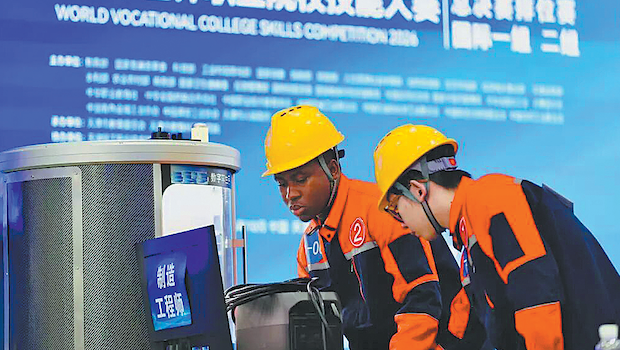
Contestants compete in a round of the World Vocational College Skills Competition 2026. CHINA DAILY
The World Vocational and Technical Education Development Conference 2026 is running from Oct 15 to 17 in Tianjin under the theme "TVET: Co-Embracing Change, Co-Forging Standards, Co-Creating Future". The third edition of the gathering is assembling 51 ministerial-level delegates representing 41 economies.
It comprises five core sessions: the opening ceremony, a plenary meeting, a ministerial roundtable, parallel sessions and the closing ceremony. Alongside are three flagship side events: the Luban Workshop 10th anniversary symposium, China technical and vocational education and training (TVET) exhibition and the final of the World Vocational College Skills Competition.
This year's World Vocational College Skills Competition has set a record for global participation, drawing 9,391 teams and 36,000 contestants across 78 countries. An Oceania division has been added to overseas competition zones, and a new track for traditional Chinese craftsmanship has been introduced to share Chinese cultural heritage with global participants.
The selection of Tianjin as host city is no coincidence; it is a recognition of the municipality's decades-long practice in vocational education. Tianjin's TVET reform experience is the only domestic case from China's vocational sector featured in national cadre-training textbooks compiled by the Organization Department of the Communist Party of China Central Committee.
For years, Tianjin has built its vocational system around three core objectives: high-level schooling capacity, high-quality industry-education integration, and high-standard international cooperation. It has constructed a complete governance framework combining statutes, action plans and special policy measures. Tianjin pioneered the revision of local vocational education regulations and issued China's first local statute dedicated to industry-education integration: Regulations on Promoting Industry-Education Integration in Tianjin's Vocational Education, enacted in March 2024.
At the operational level, Tianjin has rolled out its distinctive "1234"industry-education integration framework. Anchored by one foundational piece of legislation, two operational mechanisms, three institutional pillars and four implementation initiatives, the system ensures vocational programs keep pace with real-world industrial demands.
More than 90 percent of higher vocational majors align with Tianjin's pillar industries. Over the past five years, 139 new majors have been created while more than 100 outdated majors have been phased out. The "vocational education plus industrial park" model now covers 27 national and municipal-level industrial parks, upgrading fragmented ad hoc school-enterprise ties into systematic collaborative mechanisms.
This local reform initiative has laid solid groundwork for China's signature global TVET outreach: the Luban Workshop. The year 2026 marks the workshop's 10th anniversary, tracing back to the first site launched in Thailand in 2016.
What began as a regional pilot has grown into a national brand explicitly referenced in top-level national policy documents. These include the 2024-35 master plan on building China into a leading country in education and the 15th Five-Year Plan (2026-30) for education development. The initiative follows a guiding philosophy of "small but beautiful, people-centered".
Instead of transplanting Chinese curricula abroad, it pursues the formula "Chinese experience plus local contextual demands", focusing on training host country teachers to achieve local capacity building.
Globally, 38 Luban Workshops have been established in 32 countries. Among them, 26 sites were developed by Tianjin across 24 nations spanning Asia, Africa, Europe and North America. In addition, 65 specialized programs have been incorporated into host countries' national education systems, and 19 sets of professional standards have obtained official government recognition overseas. Luban Workshop received the World TVET Prize 2024 in acknowledgment of its innovative practice.
During the ongoing 2026 conference, China will release the Framework for World Vocational and Technical Education Standards, also known as the Beijing Agreement, a China-led international TVET standard document.
According to Peng Binbai, director-general of the Department of Vocational and Adult Education at the Ministry of Education, this signals China's TVET international cooperation is evolving from Phase 1.0 "people-to-people exchanges" to Phase 2.0"project-level cooperation", and onward to Phase 3.0 "standard-oriented leadership".
Four recommended national standards for Luban Workshop construction will also be revealed at the conference to formalize site establishment, operation and evaluation.
Tianjin's international TVET architecture rests on three interlocking pillars: the Luban Workshop brand, the World Vocational and Technical Education Development Conference mechanism, and the China-SCO (Shanghai Cooperation Organization) Vocational and Technical Education Cooperation Center. Inaugurated during the 2025 SCO Tianjin Summit, the SCO center assembles 61 experts from nine countries and promotes mutual recognition of standards across the region, teaching resource export and joint talent cultivation.
Building on the Tianjin Initiative issued at the 2022 inaugural conference and the Tianjin Consensus — a 32-nation ministerial declaration of 2024 — the ongoing event operates six international public goods: conferences, alliances, awards, competitions, exhibitions and academic journals. The China-initiated World TVET League now counts 89 member institutions from 43 countries and regions across five continents.
International officials welcome this global collaborative momentum. Julius Migos Ogamba, cabinet secretary for education in Kenya, shared his expectations in an interview with Xinhua News Agency on Oct 9. "China has taken a leading position in technical and vocational education and training. Through cooperation with China, Kenya is accelerating TVET reforms to cultivate skilled manpower required for our industrialization," Ogamba said.
He highlighted that developing-nation TVET faces practical obstacles including obsolescent teaching hardware and lingering social prejudice that frames vocational training as a fallback option for students unable to enter university. He expressed hope that the Tianjin conference would create valuable opportunities for cross-national experience sharing and deeper China-Kenya TVET ties.
"China's international cooperation in vocational education is moving from personnel exchanges and project cooperation to standard leadership," said Liu Yong, deputy director-general of the Department of International Cooperation and Exchanges at the Ministry of Education. "Luban Workshop has become a key brand of China's TVET global engagement, and this conference will translate our decade-long practical experience into shared global benchmarks."
China runs the world's largest vocational education system, graduating more than 10 million skilled learners annually and furnishing sustained talent supply for industrial upgrading.
Unlike traditional aid models centering on infrastructure handouts, the Tianjin-originated model delivers self-sustaining local industrial capacity by linking training content with real-world jobs and economic needs. Alongside main forum sessions, the concurrent World Vocational College Skills Competition is taking place, while the China TVET exhibition showcases achievements including Luban Workshop's global footprint.
Zhong Aiyamei contributed to this story.

Copyright © Tianjin Municipal People's Government. All rights reserved.

Copyright © Tianjin Municipal People's Government. All rights reserved.