中文 |


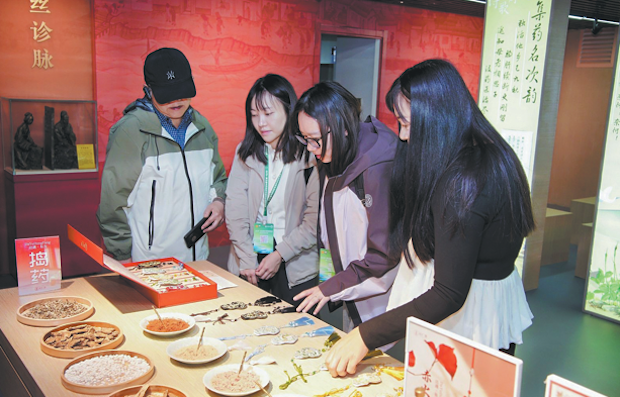
Visitors check out products of Tianjin Pharmaceutical Da Ren Tang Group during the fifth "Da Ren Tang Cup" National TCM Classical Processing Skills Competition held in Tianjin from Tuesday to Wednesday. CHINA DAILY
The 23rd World Congress of Chinese Medicine will convene at Singapore's Raffles City Convention Center from Oct 9 to 11, under the theme "Addressing Global Health Challenges and Promoting Deeper Integration of Traditional Chinese Medicine into National Health Systems". As the lead partner of this flagship global TCM event, Tianjin Pharmaceutical Da Ren Tang Group Corp is to showcase how a century-old pharmaceutical brand with roots tracing back 500 years sustains relevance through its commitment to heritage craftsmanship and forward-looking investment.
From ancient imperial pharmacy roots to modern artificial intelligence-powered production lines, from domestic market leadership to growing global presence, Da Ren Tang embodies the vitality of time-honored traditional Chinese medicine brands that evolve with the times.
With origins tracing back to 1522 and the imperial "Le Family Pharmacy" that once supplied the royal court, Da Ren Tang has stood as a cornerstone of Chinese pharmaceutical heritage for centuries.
In 1915, the Da Ren Tang Pharmaceutical Factory was established in Tianjin. Subsequently, it opened branches in Beijing, Dalian, Shanghai and Hong Kong, offering over 1,000 medicinal products and holding more than 1,400 patents. Today, it safeguards multiple national and municipal-level intangible cultural heritage items of TCM processing, keeping ancient pharmaceutical techniques alive through generations of master craftspeople.
At the final of the fifth "Da Ren Tang Cup" National TCM Classical Processing Skills Competition held in Tianjin on Tuesday, Li Gang, the 10th-generation intangible cultural heritage inheritor of manual pill rolling at Da Ren Tang, demonstrated the centuries-old technique.
With over 30 years of experience, he guided the transformation from medicinal powder to perfectly formed pills through moistening, dusting and shaking — each stage demanding patience and meticulous craftsmanship.
"Machines support much of our production today, but for precious ingredients like bezoar and musk, machine processing causes substantial waste. Overseas markets also prefer handcrafted products for these varieties. Human craftsmanship remains irreplaceable," Li said.
Generations of master pharmacists have laid the quality foundation of the brand. Guo Yufeng, a national-level ICH inheritor, led the recovery of the imperial Qing Dynasty's (1644-1911) Shoutao Pill formula in the 1980s.
With only brief historical records and no quantified standards for processing techniques such as "stir-frying to preserve properties" for fenxinmu, the woody partitions inside walnuts, Guo and her team conducted over 1,000 trials over several years. They fine-tuned heat levels and processing precision until the full imperial pharmaceutical technique was recovered.
Procedures such as milk-infused ginseng, wine-simmered wolfberry and repeated steaming and drying of rehmannia root all rely on the sensory experience of master pharmacists, and cannot be easily replicated by instruments alone.
After retiring, Guo returned to the factory on a regular basis to teach apprentices and compile process archives, systematically preserving the hands-on expertise that was once passed down only orally, so that the imperial pharmaceutical craftsmanship can be carried forward generation after generation.
"Quality identification of medicinal materials is the first line of defense for TCM quality, and talent is truly the key. If initial herb inspection fails, all modern technology becomes ineffective," said Mao Yuquan, chief expert of the quality and technology department at Da Ren Tang's medicinal materials subsidiary.
While safeguarding irreplaceable traditional crafts, the century-old brand has doubled down on scientific and technological innovation as a core growth driver. Official financial data show the company's research and development expenditure rose 29.89 percent year-on-year to 7.99 million yuan ($1.2 million) in the first half of 2026, even amid industrywide pressure.
Focusing on five core therapeutic areas — cardiovascular, respiratory, digestive, musculoskeletal and dermatological — Da Ren Tang advanced 109 R&D projects in the first half, covering innovative drugs, secondary development of blockbuster products, classical formulas, modern patches and holistic health.
Key products have won recognition in high-level national research programs. Suxiao Jiuxin Pills and Shunaoxin Dropping Pills were selected for two national key science and technology projects targeting major chronic diseases.
The SPEED real-world study on Suxiao Jiuxin Pills, involving 2,871 patients, has compiled evidence for clinical application. Seven products including Suxiao Jiuxin Pills, Qingfei Xiaoyan Pills and Neixiao Luoli Pills have been included in five clinical guidelines or consensus statements covering cardiovascular, respiratory, oncological and metabolic fields, bridging traditional empirical use with modern medical evidence.
On production lines, an AI micro-boiling robot codeveloped with Tianjin University of Traditional Chinese Medicine is being deployed in herbal extraction. Integrating AI and digital twin technology, the system translates veteran pharmacists' experience into quantifiable digital models, enabling precise process control. Operational data show it increases product yield by 13 percent and reduces energy consumption by 20 percent, and has been selected as a Tianjin municipal application case for large AI models.
Geng Yan, a staff member of the Chinese herbal pieces quality and technology department at Da Ren Tang (Tianjin), noted that the enormous variety of Chinese medicinal materials meant identification relied solely on the naked eye for generations. Authenticating powdered antelope horn, for example, was long a persistent and labor-intensive challenge.
"Today, more sensitive machine-based detection systems make identification far more straightforward and consistent," Geng said. "This opens up far more possibilities for the perfect integration of traditional medicine and modern quality standards."
Beyond factory floors, Da Ren Tang is extending digital innovation to consumer health services. It launched China's first cardiac health AI assistant in partnership with Alipay, bringing cardiovascular health services directly to households.
It also built a digital chronic cardiovascular disease management platform with Tencent Health, covering over 1,000 offline pharmacies and improving accessibility of core products in out-of-hospital markets.
According to the latest China Cardiovascular Disease Report, China is home to 330 million cardiovascular patients, 44 percent of whom are under the age of 39. Cardiovascular conditions require full-cycle care spanning emergency treatment, rehabilitation, chronic disease management and daily health maintenance, driving growing demand for both clinical and home-based care.
In response, Da Ren Tang has moved beyond a pure pharmaceutical positioning, identifying 16 high-risk scenarios across five dimensions of space, time, population, psychology and behavior, and developing nearly 100 daily health solutions for preventive care.
The brand has also revitalized its connection with younger consumers through creative branding. It has advanced the third phase of its Suxiao Jiuxin public welfare program, delivering 823 public health lectures to date.
It has also entered youth cultural scenes such as the Strawberry Music Festival, presenting TCM health concepts in approachable, engaging formats. Its community wellness workshops, built around the philosophy of "five seasons matching five flavors", offer freshly made herbal pastes and baked goods, bringing "ancient formulas for modern life" to urban consumers.
Strong innovation has translated into solid business performance. In the first half of 2026, Suxiao Jiuxin Pills generated 1.38 billion yuan in revenue, up 22 percent year-on-year and consistently ranking first in the retail cardiovascular category. Net profit after nonrecurring items grew 7.43 percent year-on-year, reflecting balanced growth in both current operations and long-term R&D investment.
"The development of modern science and technology has given new luster to many traditional folk formulas and preparations," Mao Yuquan observed. "Through pharmacological and medicinal research, science has quantified many experiences that ancient practitioners could only describe in vague terms, turning age-old wisdom into measurable, replicable clinical value."
With TGA certification from Australia and market access to 24 countries and regions, Da Ren Tang has set up an overseas headquarters in Singapore as a springboard for Belt and Road markets. Its international expansion will be highlighted at the Singapore congress, a milestone in the brand's global journey.
From craftsmanship demonstrations at competition arenas to intelligent transformation on production floors, from community wellness workshop experiences for urban residents to product exports reaching dozens of countries and regions worldwide, Da Ren Tang translates 500 years of TCM heritage into tangible products and accessible services.
Its model offers a blueprint for TCM modernization: preserving the fingertip craftsmanship of master pharmacists while embracing technological progress, so that ancient medical wisdom can continue to serve contemporary health needs at home and abroad.
Meng Jiarui contributed to this story.

Copyright © Tianjin Municipal People's Government. All rights reserved.

Copyright © Tianjin Municipal People's Government. All rights reserved.