中文 |


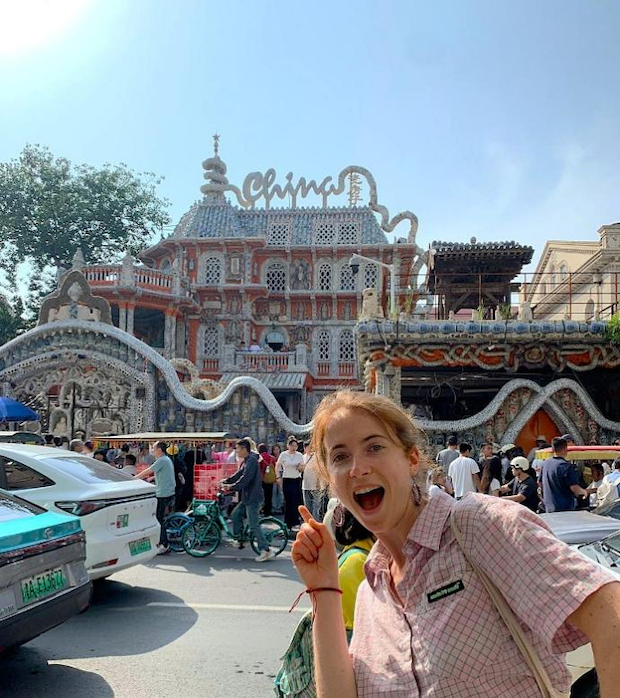
Jane Jones poses with the impressive China House in Tianjin. [Photo provided to chinadaily.com.cn]
My trip to Tianjin was in fact rooted a few hundred miles south in the city of Luoyang, Central China's Henan province. It was there that I discovered the enchantment of the qipao, a traditional Chinese dress, and the joy of traditional Chinese handcrafts. From Luoyang, I returned to Beijing where I proceeded to share my new-found interests with friends and teachers. One such friend, sparked by my enthusiasm, suggested a weekend in Tianjin, where he knew of a decent qipao maker. The idea was free from oppressive details but loosely based on the idea of searching for the "perfect qipao".
We took the high-speed train from Beijing to Tianjin and arrived in a place which by comparison with the capital seemed almost barren: a distinct lack of people. Leaving the station, we were greeted by the 12 zodiac signs decorating the massive Century Clock in the plaza in front of the station. The effect was one of having entered into Alice in Wonderland; far from my time-obsessed life in Beijing, Tianjin is a city where the distinction between history and modernity feels less apparent.
Our accommodation was a quaint bed and breakfast-style lodging tucked away in one of Tianjin's old European-style neighborhoods. Black lampposts decorated with flower baskets and tiled gable roofs transported me straight back to my childhood in London. Every house seemed equipped for a large Victorian family to live in; Alice could well have begun her travels from this very spot.
After dropping off our luggage, we headed off on foot to complete our mission; Tianjin seems to be one of the few cities in China where pavements are truly meant for walking. The roads are pleasantly shaded with plenty of small, independent shops and cafes to entertain the leisurely passer-by. We wandered casually for about 20 minutes before stumbling across a house which confirmed my belief that I had fallen into Wonderland. Or maybe I had walked straight back into my life as a tour guide in Barcelona.
Before we even made it to the qipao studio, I was caught speechless by the presence of an almost explicit reference to Antoni Gaudi: The China House. It is a phenomenal piece of ceramic-covered architecture, functioning as a honeypot that lures busy photo-snappers from far and wide. Herds of people risk their lives against moving traffic in order to get a picture of this house. The scene is reminiscent of the crowds around the Sagrada Familia in Barcelona (Gaudi's masterpiece and officially the tallest church in the world). The China House is a piece of modernist magnificence in the heart of Tianjin. It is an undiscovered gem for many foreign tourists and a proud symbol of Chinese culture for domestic sightseers.
Opened to the public in 2007, Tianjin's China House is an eccentricity not to be missed. The facade presents a history of Chinese ceramic culture that barely masks the twisting presence of a dragon climbing across the rooftop. This detail is also perfectly aligned with the facade of the Casa Batllo in Barcelona, renovated by Gaudi between 1904 and 1906, roughly a century before the China House got its makeover. Could we assume this to be some sort of centenary celebration of one of Gaudi's best-known works? The roof of the Casa Batllo towers above one of Barcelona's main avenues, and when inspected closely reveals a surprising truth: the roof is in fact the scaly back of a dragon. Below the dragon's belly, Gaudi impresses passers-by with a facade decorated with over 300 ceramic plates and broken tiles, or trencadis, a decorative technique popularized by Gaudi. Every day, thousands of tourists gawp at this piece of modernist architecture. Little do they know that Tianjin has its very own response to Europe's turn-of-the-20th-century Art Nouveau movement.
Tianjin impressed me on a personal level. It is a city that boldly crosses time and culture in order to construct its very own identity based on a long history of foreign influences. There are still obvious nods to European design; however, it is clear from the proud title that crowns the top of the China House that this level of richness can only be found in one place.
The author is a British student and tour guide in Barcelona, Spain. She is currently studying at the Beijing Language and Culture University.

Copyright © Tianjin Municipal People's Government. All rights reserved.

Copyright © Tianjin Municipal People's Government. All rights reserved.